

OKR : define your goals and share them
- Jennifer Thomas

- 9 oct. 2018
- 3 min de lecture
"Ideas are easy, execution is everything. And it takes a team to win" John Doerr.
He is the author of Measure What Matters, a book about goal-setting. Doerr has backed some of the world’s most successful entrepreneurs, including Larry Page, Sergey Brin, and Eric Schmidt of Google; Jeff Bezos of Amazon.com; and Scott Cook and Bill Campbellof Intuit.

What is it for ?
Big part of OKRs is making sure each individual knows, what's expected of them at work. OKRs are kept public in front of everyone, so people and teams move towards the same goals and know what others are focusing on.
It's lightweight, does not consume time or resources, but gives strong benefits for productivity, focus and company culture.
Implemented initially in 1970s by the President of Intel Andy Grove it later spread across many tech companies, especially when Google started using them early on. Nowadays OKRs are used by tens of thousands of teams and companies from SMEs to Fortune 500. Google, LinkedIn, Intel, Zynga, Sears, Oracle and Twitter are just some well-known OKR users who love and use them.
OKRs are often loved by leaders and managers seeing their people start moving towards important goals, not small unimportant tasks. Focus and productivity is the result of good OKR process.
OKRs consist of a list of 3-5 high-level objectives. Under each objective then usually 3-5 key measurable results are listed.
How can you make your own ?
You can read Jon Doerr's book and watch this 1-hour-Google video. Personally, I loved the book because I actually suffered from a lack of visibility at one time in my career. And I think this is a good answer. I am also not a big fan of politics in companies when it is against putting all the departments 'effort to serve the client the best way.
So as mentioned above, OKRs consist of a list of 3-5 high-level objectives. Under each objective then usually 3-5 key measurable results are listed. They are flexible and need are 3-months focused. But feel free to adapt to your industry and company.
Here are some tips to make your job easier:
The goals must be ambitious enough to get you out of your comfort zone.
The key results are measurable, they must be a number.
Ideally, you can reach 70% of your OKRs.
Achieving 100% means that your OKRs are not ambitious enough.
A bad score should not be synonymous with punishment.
Limit your OKRs, 5 goals with 5 key results for each of them is usually enough.
4 examples here :


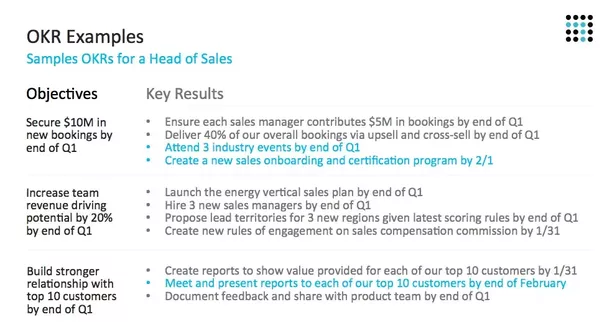

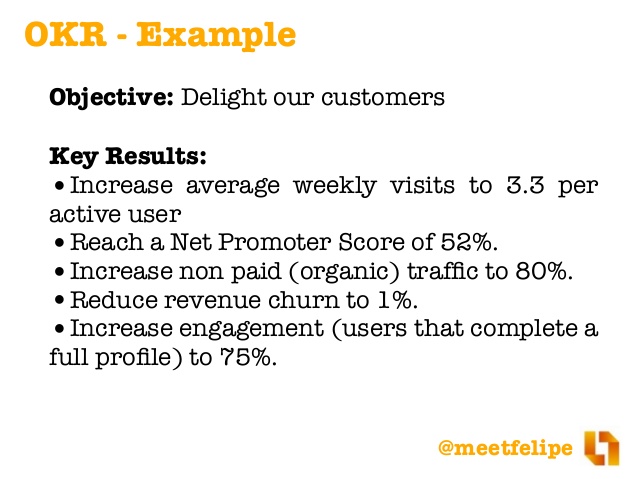

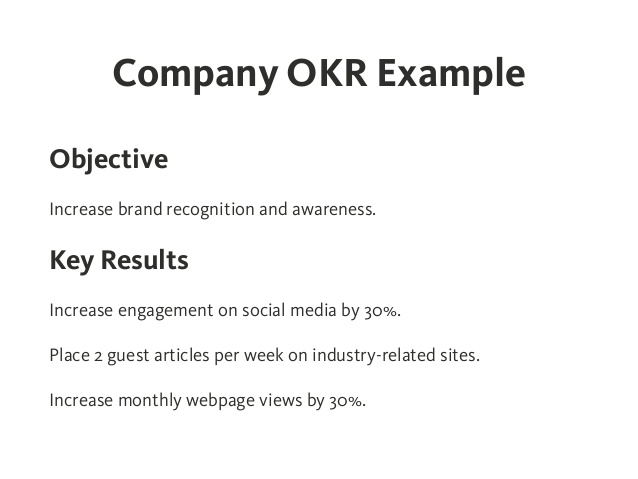


You can also use tools like Trello, Jira. Slack.

What could be the limits ?
People love hitting their marks. Crossing off every to-do is always the goal. But when it comes to effective goal-setting, you should never get to 100%. If you do, you’re not trying hard enough.
If you don't set your goals high, you won't force the right questions.
Be careful when linking it to bonus.
“OKRs are not designed to be used as a weapon against your employees,” he says. “They are a tool for motivating and aligning people to work together. They increase transparency, accountability and empowerment."
For example, Davis says, members of Swipely’s sales team have part of their compensation tied to the number of deals they close. That makes sense. But if OKRs were always tied to money, you’d never see other, diverse objectives in the mix. A salesperson would never create an objective to improve a training program, for instance, even though training programs are vital to the company’s overall success.
And be careful not to discourage your teams.
Make sure there is enough communication and transparency.
That people are ready to help each other.
Inspirational sources :
https://www.whatmatters.com/
Examples :
https://blog.trello.com/fr/okr
http://firstround.com/review/How-to-Make-OKRs-Actually-Work-at-Your-Startup/
Software :
https://www.capterra.fr/directory/30947/okr/software
www.trello.fr


Commentaires